
The Denmark Mural Project
Celebrating the Helsingor Ship yards
Created and installed Summer 2013
From The Studios of Garin Baker
Carriage House Art Studios
November 1st 2013


Helsingor Mural to scale

30 ft. high x 25 ft. wide. Helsingor, Denmark, 2013
I think it was late December of 2012 I received an e-mail from Elisabetta Saiu, artistic coordinator for the Kunst og Byrum, "Helsingør commune", in Denmark about creating a mural celebrating the Shipping Industry of this amazing small town about 60 miles north of Copenhagen. I thought wow, what a great subject, but knowing practically nothing about this area and its history, I was about to embark on quite a journey.
At first when Elisabetta's contacted me with her enthusiastic accent, being from Sardinia, Italy, it threw me off a bit. I thought she was saying "chipping industry" during our initial conversations. What I was about to learn was that The Ministry of Culture in Denmark creates a wide array of Cultural Arts Festivals every year inviting artists from all over the world to come and create works of visual and performance arts in their small country of a population of 5.5 million.
Very cool!
At first I would be required to create using some amazing historical source material, provided by Elisabetta a rendering and design for the eventual 30 ft. high X 25 ft. wide Mural that would be installed in the center of Helsingor directly across from what once was a huge ship building factory that has now and is presently being transformed into a Museum, Cultural Center as well as a Business Incubator project. Also very cool!
I was amazed to learn that as a working factory for over 100 years, employing at it's hight, more than 20 thousand men and women building the worlds most celebrated freighters and luxury yachts. Also these workers had an amazing heritage and history of ship building stretching back several hundred years to the Viking Age. I also learned that these Viking ship builders were well advanced of their European neighbors and for a time dominated and perfected global navigation with their light weight wooden longships.
In relationship to the Mural which would feature recent history of the Helsingr Ship Yards, here are a just few of literally hundreds of amazing reference shots I was provided by the Museum through Elisabetta.




Garin Baker
November 2nd 2013
At first when Elisabetta's contacted me with her enthusiastic accent, being from Sardinia, Italy, it threw me off a bit. I thought she was saying "chipping industry" during our initial conversations. What I was about to learn was that The Ministry of Culture in Denmark creates a wide array of Cultural Arts Festivals every year inviting artists from all over the world to come and create works of visual and performance arts in their small country of a population of 5.5 million.
Very cool!
At first I would be required to create using some amazing historical source material, provided by Elisabetta a rendering and design for the eventual 30 ft. high X 25 ft. wide Mural that would be installed in the center of Helsingor directly across from what once was a huge ship building factory that has now and is presently being transformed into a Museum, Cultural Center as well as a Business Incubator project. Also very cool!
I was amazed to learn that as a working factory for over 100 years, employing at it's hight, more than 20 thousand men and women building the worlds most celebrated freighters and luxury yachts. Also these workers had an amazing heritage and history of ship building stretching back several hundred years to the Viking Age. I also learned that these Viking ship builders were well advanced of their European neighbors and for a time dominated and perfected global navigation with their light weight wooden longships.
In relationship to the Mural which would feature recent history of the Helsingr Ship Yards, here are a just few of literally hundreds of amazing reference shots I was provided by the Museum through Elisabetta.


I then set about developing my rough design and wanted to create from a human point of view a heroic sense of these laborers combined with the monumental task of building huge vessels larger than human scale. This would prove quite challenging. Having been familiar with some imagery available and with the help of a fellow artist Kevin Ferrara, (who has a treasure trove of reference material on great artists their artworks) he enlightened me and sent me great works done by Thornton Oakley and others. With this reference, combined with many other sources, like the inspirational work of Muralist Frank Brangwyn and Joseph Sert, I was able to decipher through tons of reference material and boil things down to a composition I felt was quite strong given all the parameters. What was also quite important to me was to show the faces of the workers, which I notices in many other renditions on this subject matter is avoided in order to demonstrate the scale of the work being accomplished. So I altered the composition several times in order to create a point of view and composition from eye level.
Here are some of my initial rough sketches for the project.

Rough abstract design

Design within wall scale

Free form design

Thornton Oakley tracing.

figure studies

Brangwyn figures
At this point I felt the composition taking shape and the strength of the design and compelling power of my intentions coming through. I begin to work it out in two different directions. Both rough sketches were presented to the Cultural Organization and Committee Members back in the Early Spring of 2013.

Rough Sketch #1

Rough Sketch #2
Feed Back from the Committee was quite positive and I was secretly hoping they would select sketch #1, but you never know. So in this case I boldly said to Elisabetta that sketch #1 is the one I wanted to paint. Luckily that's the one the Committee had shown a liking to anyway. They just wanted to make sure I included the amazing and world famous Kronborg /Helsingor Castle.

So I was set to begin the full rendering.
I worked it up on several joined together sheets of (felt gray) Canson Paper using black and White Generals Charcoal Pencils. This is the most crucial stage in large scale Traditional Mural Painting. All your proportions and design elements must be placed just right since things don't get better when you go large. The incorrect aspects and miss alignments in the drawing tend to incorrectly multiply and look quite out of place when done without compositional planning and accurate draftsmanship. I also wanted to create a design and composition that included the interior and exterior aspects of the shipyard. This proved an interesting design problem. So I decided that a literal depiction of space would be sacrificed in order to create a montage of elements but combined them in a way so they could be seen a one scene without being a typically dated montage composition.
Here's the finished Rendering.

Helsingor Mural Rendering, 48 "x 64", black and white charcoal on Canson paper.
With the Rendering now approved in the later part of the Spring 2013, it was time to begin the Mural painting execution stage in my studio in New Windsor NY. Quite a bit of planning and Skyping was needed since my only trip to Denmark would be to install the painted Mural. The exterior side of this 4 story building, which would receive the Mural had to be measured critically in order to decide it's final size and dimensions. We decided that a symmetrical placement under the building's existing architecture would work well, so the final dimensions of the painted Mural would be 25 ft. wide x 30 ft. high. This would also allow me to work on (parachute cloth). A cotton woven light weight fabric that can be purchased in 5 ft wide rolls. Simple math calculations would determine that 15 sections would be needed, each 5 ft wide by 10 ft. high. The paint I used is manufactured by Nova Colors in California, and is a light fast heavily pigmented acrylic paint made specifically for muralist and other artist paintings. It works incredibly well on 2-3 coated gessoed (parachute) cloth. Over the years I have set up my studio to complete this process as I have done several projects using this method as well as oil paints on gessoed canvas for primarily interior mural projects. Working in sections is very similar to the way many Traditional Murals were done even though many believe and they look as if they were painted directly on the wall.
Here are a few shots of me working on several of the sections in my studio.

Mural section laid on the floor to double check, making sure all the seems line up just right.


After 5-6 weeks of climbing, mixing, panting and organizing the process, all the 15 sections, (each 5 ft. x 10 ft. sections) were completed. All the sections were rolled into 3 tubes containing 5 sections each and along with a small amount of touch up paint and brushes all was shipped to Elisabetta in Helsingor, Denmark in mid July 2013.

Arriving In Denmark in late July of 2013 I was greeted at the Copenhagen Airport by an enthusiastic and completely welcoming Elisabetta. I asked if I could rent a car to get around and with a puzzled look on her face she said, "no car, we take train" OK? A quick and short connection to the train and a pleasant and smooth 40 min ride followed. We arrived in Helsingor. Wow, incredibly easy!
My hotel was within walking distance to the Mural site and the small town of Helsingor was as quaint, well maintained and laid out as one would expect of a well managed European small city to be. Beautiful and very,very sweet!


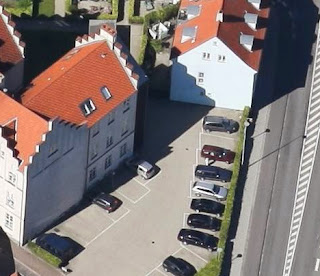
The Site where the mural would be installed is quite wonderful. A large faced stuccoed building standing 4 stories tall with a large parking area in front. It faces a main road just across the street and commuter rail line from the huge shipyard and factory where thousands worked over many generations building the worlds most amazing ships. On the other end of the courtyard/parking area is another building where two other artist, one from Spain and another from Italy had been working on scaffolding doing a large mural for the past several weeks on site.


The Install:
Prior to my arrival Elisabetta had made arrangement to have all the lift equipment and two wonderful assistants made available to the project. Jasper and Simon were both young men in their early twenties, very well versed in arts and music in addition to many other interesting subjects. They spoke multiple languages and even tried to help me with my crude attempts at danish. Both struck me as extremely mature for their age and were completely motivated to help me in this process. I was utterly impressed. Having trained several young artist in US and not that Mural installations are rocket science, these two young men were incredibly fast on the uptake. So much so, that on day one, we were able to, with a small amount of tutelage, adhere a good portion of the Mural to the wall.
Using an Acrylic palmar glue similar to Gel Medium, applying it to the face of the wall and the back of the parachute cloth sections, starting with a level line across the top, we started glueing the section to the wall.


Lunch break from the back of Elisabetta's auto.


End of Day One.
Day two of the instal was a continuation of the first but I knew once the figures started to appear on the wall, passers by would become more interested and slow our progress with questions about the project. Almost all were quite pleasant and enthusiastic about what we were doing and thought a fine addition to the side of this blank wall in their town. Some were very curious about the project having had several generation and family members whom worked at the shipyards and on a few occasions thought they had recognized some of the workers in the foreground. Very Cool!


The Local Press would soon find us and published several stories about the project.


On one occasion a local resident found his grandfather in the Mural and the media followed up with several stories about "Who are the workers in the Mural?"
Very cool!
As an artist bringing these images back from generations long gone by it was an amazing feeling. Back to life, these stories of workers and simple folk having spent their lives toiling away at the Shipyards. Now a new generation of readers and viewers would know from what and how this town sustained itself for hundreds of years. In one way shape or form it's a great success when art can initiate timeless human stories from one generation to the next through expressed experiences and imagery.

With day two completed were had accomplish quite a bit. All the sections of the mural were installed and only remaining were some minor touch ups. This was completed on day three and the following day four we were able to apply 2 rolled coats of a protective clear gloss acrylic varnish. A few days later it was dedicated and a huge crowd attended, including dignitaries, speeches and beer.
We're in Denmark, Of Course!
Very, very cool and thrilled to have completed such a wonderful Project!
Images below of the completed installed Mural including a hi res image.
Sorry for this long post, but it was a great project that I hope brings much enjoyment to the people of Helsingor for many years to come.
Thank you Elizabetta and Helingør municipality,"Helsingør commune" and The Culture Chef for the Helsingør Municipality Jørgen Sprogøe Petersen in Denmark for making and enabling me towards creating this project and making it such a wonderful reality!


Thank you for taking the time hope you enjoyed your visit.
Garin Baker
November 2nd 2013


